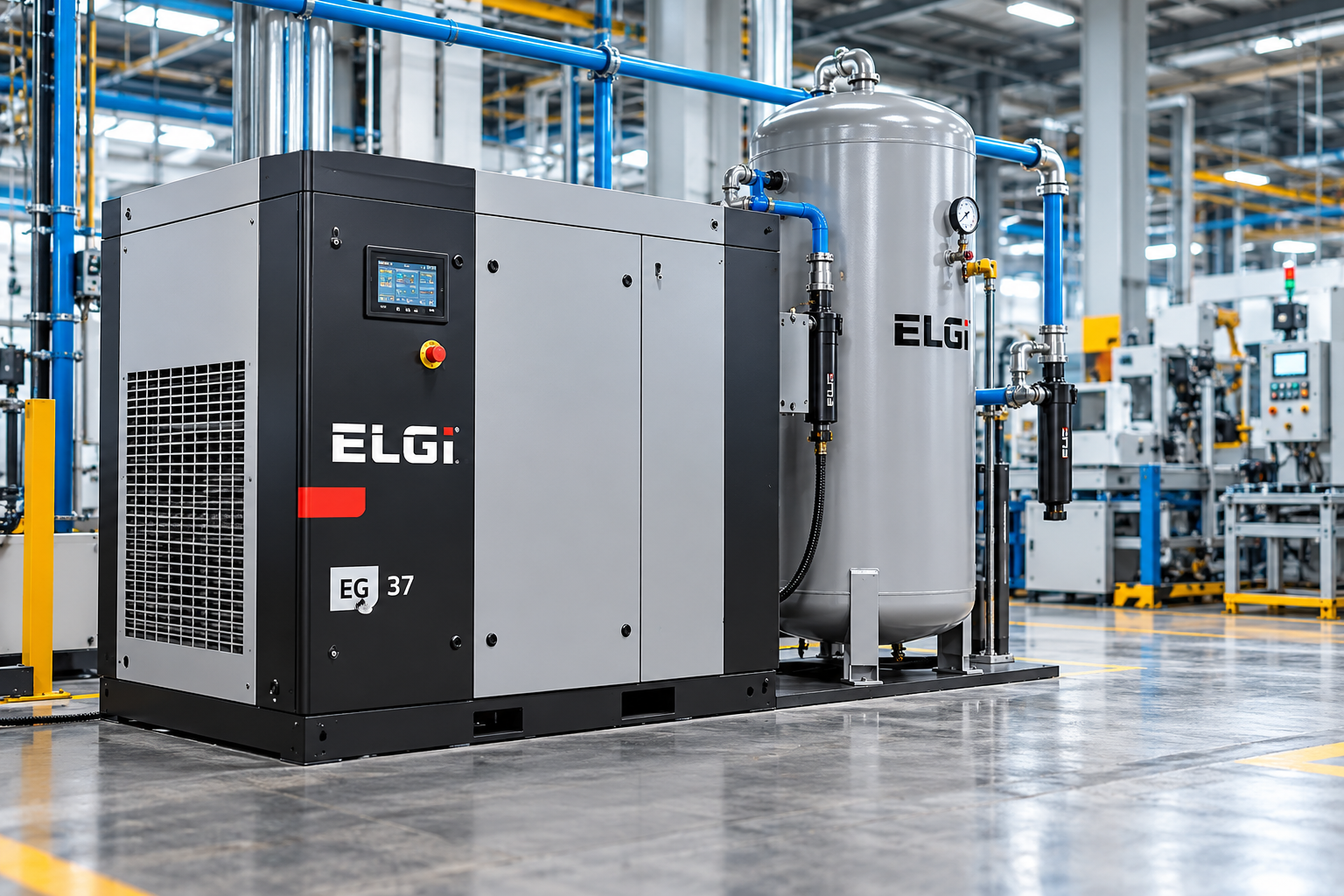

The Role of Industrial Air Compressors in Everyday Production
Air Compressor Dealers in Chennai
“Reliable production often begins with a reliable supply of compressed air.”
Have you ever wondered how so many machines in a factory keep working without stopping for every small task? Behind many manufacturing operations is a steady supply of compressed air used to power tools, operate pneumatic equipment, support automation, and carry out processes that require controlled airflow. An industrial air compressor takes ordinary atmospheric air, compresses it, and delivers it at the pressure needed for different applications. The right system can therefore influence production speed, equipment performance, energy use, and overall workflow. In this blog, we will explore the role of industrial air compressors in everyday production, where they are used, what affects their performance, and why selecting suitable industrial Air Compressor Dealers in Chennai can help businesses match their equipment to their actual production requirements.
How Air Compressors Support Different Machines
How Air Compressors Support Different Machines
Industrial air compressors can provide compressed air for a variety of machines utilized in manufacturing and processing. A consistent and reliable supply of air is necessary for pneumatic cylinders, valves, actuators, and automated devices to repeatedly move. Compressor systems must be matched to the air needs of the machines, since the requirements vary from machine to machine.
Common applications include:
- ⚙️ Pneumatic machinery: Compressed air can be used to drive cylinders, actuators, and other pneumatic devices.
- ⚙️ Production equipment: Some machines are used to form, assemble, handle, or process using compressed air.
- ⚙️ Control systems: Air can be used to control valves and other devices in industrial equipment.
- ⚙️ Cleaning applications: Compressed air can also be used for certain cleaning and blow-off applications.
Why Pressure Stability Matters in Production
Reliable pressure supply may be significant if machines rely on compressed air for repetitive actions. When multiple machines pull air simultaneously, sudden pressure changes can impact the speed, strength, or dependability of pneumatic machines. Proper pressure allows for more consistent operating conditions throughout the production floor.
The necessary pressure will vary with equipment and use, and the compressor and distribution system should be designed to meet the actual operating needs.
Pressure stability can affect:
- ⚙️ Machine performance: Equipment can run more consistently when the necessary pressure is provided.
- ⚙️ Repeatability: Pneumatic operations that repeat can be executed more consistently.
- ⚙️ Operation of tools: Air-powered tools can work differently under varying conditions of pressure.
- ⚙️ Process control: Some production processes require sustaining specific ranges of pressure.
- ⚙️ System reliability: With a reliable air supply, there are fewer interruptions due to poor pressure.
Compressed Air in Automated Operations
Oftentimes, automation requires repetitive movements that must be controlled and reliably powered. Pneumatic cylinders, grippers, valves, and other elements of automated production systems can be driven by compressed air. It provides fast and repeatable motion, which makes it ideal for applications that require similar motion to be repeated.
The use of compressed air systems can be significant with increasing automation in production.
Compressed air can be used for automation in the following ways:
- ⚙️ Actuation: Pneumatic cylinders can provide controlled linear motion.
- ⚙️ Clamping: Air-operated devices can secure components in a desired location.
- ⚙️ Pick and place: Pneumatic grippers can help move certain items.
- ⚙️ Process and Control Valves: Compressed air may be used to initiate and control process and control valves.
- ⚙️ Frequent cycles: Pneumatic systems can be used in automated machinery, where frequent cycles are required.
Handling High-Volume Air Requirements
If a large production facility is being used, then numerous machines are likely to be running simultaneously, which results in a significant demand for compressed air. The system has to be capable of providing air during high-demand periods, not just during average operating conditions. Having a complete understanding of the total demand can help prevent pressure drops and unnecessary stress to the compressor.
If high volume is required, it may include:
- ⚙️ Multiple machines: Several pieces of equipment can be taking air at the same time.
- ⚙️ Peak demand: If there are high periods of demand for compressors, extra compressor capacity must be provided.
- ⚙️ Production changes: Air may be required for various production schedules.
- ⚙️ Air storage: Receivers can be used to help control short-term changes in demand, if designed appropriately.
- ⚙️ System capacity: The compressor system should be designed to meet the overall requirements.
How Air Quality Affects Industrial Processes
Compressed air is in direct contact with equipment and, in certain applications, with the product or the production environment. Moisture, oil, dust, and other contaminants can, therefore, impact pneumatic components or cause issues for processes where clean air is needed. Treatment systems can be installed to filter and/or reduce undesirable substances before the air is delivered to sensitive applications.
This is an important component of compressed air system planning in terms of required air quality, depending on the industry and specific process.
Air quality may relate to:
- ⚙️ Water control: Water may be removed to help protect downstream systems and equipment.
- ⚙️ Oil management: If there is a need to prevent oil contamination, appropriate filtration can be required.
- ⚙️ Particle filtration: Filters can be used to filter out dust and solid particulate matter in the airflow.
- ⚙️ Requirements for applications: Cleanliness requirements should correspond to the production process.
Supporting Pneumatic Tools and Equipment
Pneumatic tools can be used in many workshops and factories as a source of operating power. Any compressed-air-powered devices such as drills, impact tools, grinders, spray equipment, etc. can be connected to an appropriate compressed air system. However, their performance relies on sufficient airflow and pressure for the tool that they are going to be used on.
Pneumatic equipment could consist of:
- ⚙️ Impact tools: Compressed air can be used to drive tools such as those that are used for fastening and assembly.
- ⚙️ Air drills: There are pneumatic drills that can aid certain operations in a workshop and manufacturing.
- ⚙️ Spray equipment: Controlled application of sprays is made possible with the help of some spraying systems that apply the sprays using compressed air.
- ⚙️ Grinders: Air-powered grinders can be used for appropriate grinding and fabrication applications.
Where Energy Efficiency Makes a Difference
Compressed air can be a valuable utility, but it takes energy to make compressed air. An inadequately maintained compressor, air leaks, excess pressure, or an oversized compressor can cause unnecessary energy waste. The analysis of the compressed air generation, storage, and distribution in the system can then provide a path forward for a more efficient system for the business.
There are ways of improving efficiency:
- ⚙️ Leak reduction: Sealing the air leaks will avoid needless compressor running.
- ⚙️ Avoid excessive pressure: Lower pressure can be used to avoid energy use.
- ⚙️ Right sizing: A correctly sized compressor will function more efficiently.
- ⚙️ Energy-efficient equipment: Modern compressor technologies may provide features that can enhance energy efficiency.
- ⚙️ Ongoing maintenance: Clean filters and properly maintained components can help ensure efficient operation.
Dealing With Heat, Moisture and Air Contamination
The compression of air generates heat, and the air in the atmosphere is naturally moist and has airborne particles present. These factors can cause damage to the compressor, air lines, and equipment if not properly cooled and treated. Aftercoolers, dryers, filters, separators, and drains may thus be incorporated into the system design to control the quality of the compressed air.
Protecting the system may include:
- ⚙️ Heat management: A cooling machine can be used for cooling of compressed air.
- ⚙️ Moisture separation: Condensed water can be separated from the mixture using separators and drains.
- ⚙️ Air drying: Dryers can help to remove moisture before it reaches sensitive equipment.
- ⚙️ Condensate management: Water collected needs to be managed appropriately for optimal system performance.
Also Read This:
- The Key Decisions Behind Choosing the Right ELGi Air Compressor
Keeping Production Moving With the Right Air Support
An industrial air compressor may not be the machine that directly makes a product, but it can play an important supporting role across the production floor. From powering pneumatic equipment and automation systems to maintaining consistent pressure for specialised processes, compressed air can influence how smoothly different operations run. The real value comes from having a system that matches the workload, air quality requirements, pressure needs, and future demands of the facility. For businesses exploring Air Compressor Dealers in Chennai, understanding these requirements can make it easier to select a compressor solution that supports reliable performance rather than simply adding another machine to the production line.
Frequently Asked Questions
Everything you need to know about Air Compressor Dealers in Chennai
1. What is an industrial air compressor used for?
Industrial air compressors supply compressed air for machines, pneumatic tools, automation systems, material handling equipment, and various manufacturing processes.
2. Why is stable air pressure important in production?
Consistent pressure helps pneumatic machines and tools operate more predictably. Pressure fluctuations can affect equipment performance and may interrupt certain production processes.
3. How do I know what size compressor my factory needs?
Compressor size depends on factors such as total airflow demand, required pressure, number of connected machines, operating hours, and periods of peak air consumption.
4. Does compressed air need to be treated before use?
In many applications, yes. Moisture, oil, and particles in compressed air can affect equipment and certain processes, so filters, dryers, separators, or other treatment equipment may be required.
5. How can I choose suitable Industrial Air Compressor Dealers in Chennai?
Look at the available compressor types, technical specifications, capacity options, installation assistance, maintenance support, spare parts availability, and after-sales service before selecting a supplier.