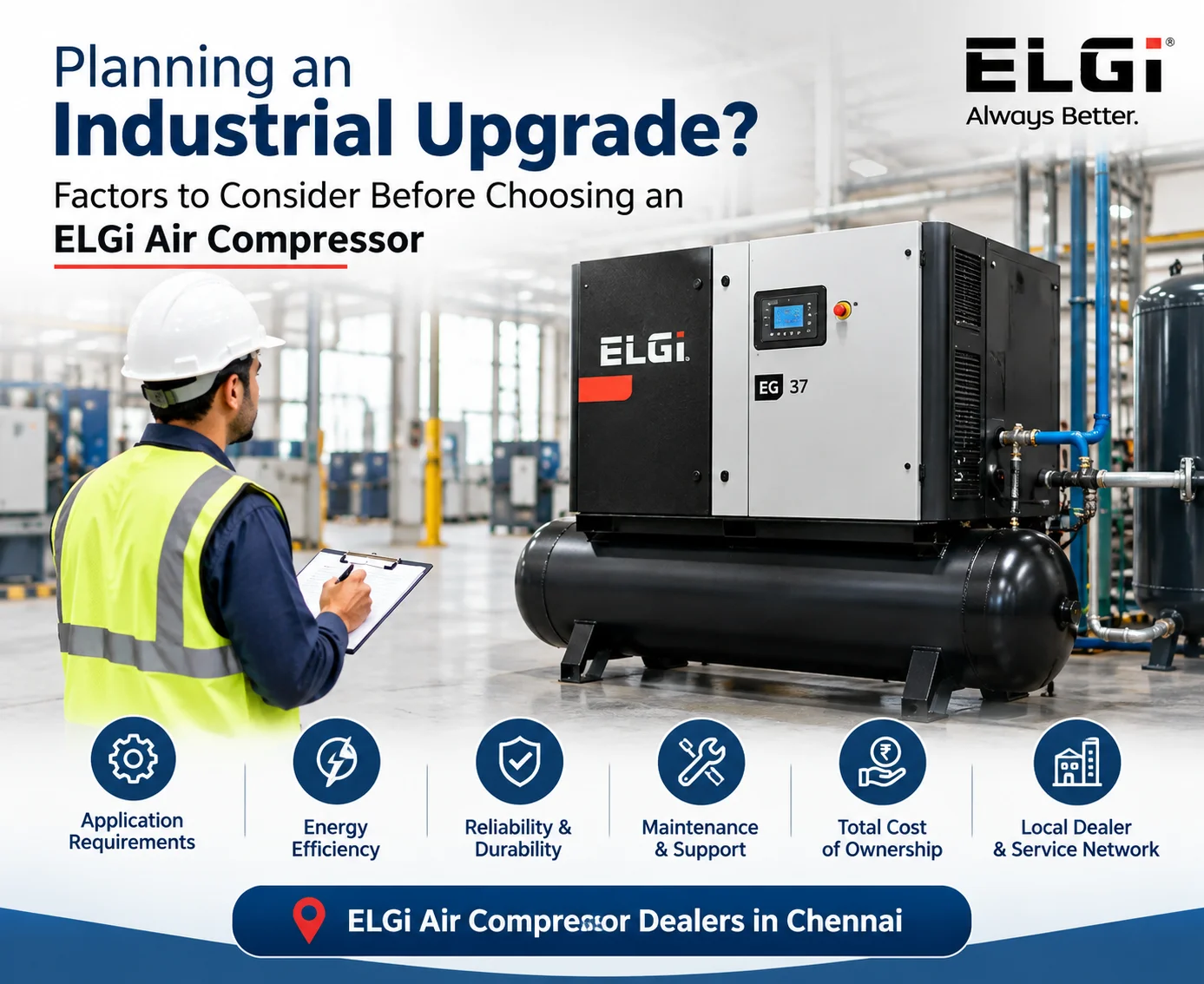

Planning an Industrial Upgrade? Factors to Consider Before Choosing an ELGi Air Compressor
ELGi Air Compressor Dealers in Chennai
Power is not in the noise, but in the flow that never stops
Industrial improvement projects are frequently motivated by a desire to increase production speed, lower operating costs, and ensure quality in production. Although machinery, automation and workflow improvements are often talked about, compressed air systems are also part of many of the day-to-day industrial processes. An air compressor can directly affect overall efficiency, whether for running pneumatic tools, handling air-powered packaging machinery or material handling equipment. Making the right equipment selection goes beyond price or capacity. Consideration should be given to the business's air use, air pressure, energy consumption, installation, and maintenance requirements. Industrial buyers can help understand the requirements and find a solution for their applications with the help of reliable ELGi Air Compressor Dealers in Chennai.
Let’s dive into this blog to explore the key factors to consider before choosing an ELGi air compressor for your next industrial upgrade.
ELGi Air Compressor Dealers in Chennai
“The right equipment choice today builds the foundation for better industrial performance tomorrow.”
1. Understand Your Factory's Compressed Air Requirements
The demand of compressed air varies from a single industry to another industry because of the production process, the machinery used and their working hours. A compressor that works one time may not work the next. Knowing what actual air requirement you have should be the first step in the selection process, therefore. The first step is to determine the equipment that relies on compressed air and to make an estimate of the compressed air usage.
Various pneumatic tools, spray painting systems, assembly lines and automated production equipment can require different airflow rates and pressures. Take into account if there are multiple machines running at the same time or if the air requirement varies during the day. Also, there is a need to differentiate between peak demand and average demand. Relying on average consumption may mean that there isn't enough air available when production is heavy. Conversely, too large a compressor can be an unnecessary investment and energy cost.
2. Evaluate Airflow Capacity and Operating Pressure
One of the most crucial equipment selection factors is compressor capacity. Properly designed airflow and pressure will ensure that the connected machinery is provided with the air required for proper operation. Don't select a compressor by its motor size or by the size of the compressor advertised in the specifications. Actual performance is dependent on the airflow at the desired operating pressure.
You can't make your decision without taking these factors into account:
3. Compare Energy Efficiency and Long-Term Operating Costs
The air compressor's purchase price is just one of the several components of the overall cost of the unit. Over the working life of the equipment, costs can be substantial for electricity, maintenance, consumables and possible loss of production. An energy-efficient compressor can assist in controlling these expenses, especially if compressed air is needed to be used for longer operating periods. But, assessing efficiency should be done based upon the actual demand profile rather than just a single specification. A good assessment enables businesses to evaluate options on a value basis, rather than just looking at the front-end cost.
If you are looking for a more accurate comparison, take into account the following:
- ⚙️ Electrical power consumption: Check the electric input of the compressor at appropriate operating conditions.
- ⚙️ Specific power: If available, compare the amount of power needed to provide a specified amount of compressed air.
- ⚙️ Operating Schedule: Work out the average electricity consumption from the daily running hours and number of working days.
- ⚙️ Load variations: Identify the extent of variation in load and the possible value of using variable speed technology.
- ⚙️ Energy waste: Check the distribution system for air leakage, as leaks can cause energy loss even with efficient compressor units.
- ⚙️ Lifecycle costs: Servicing, filter replacement, lubricants as applicable, and any other scheduled maintenance costs are included.
4. Choose the Right Compressor Technology for Your Application
There are various compressor technologies that are tailored to specific operating conditions. Choosing the right kind ensures that the equipment can easily manage the load without adding to complexity and cost.
Some key considerations for assessment are:
- ⚙️ Rotary screw air compressors: They are typically used in industrial applications where compressed air is needed for long periods and consistent air production is required. Depending on the model, they can be used for manufacturing, automotive workshops, packaging operations, and other uses.
- ⚙️ Reciprocating air compressors: These can be used in workshops and for applications that have intermittent or comparatively low compressed air requirements. They are suitable for various pressures, duty cycles and capacities.
- ⚙️ Oil-free air compressors: These can be considered if the application presents special demands on the oil content in the compressed air, such as in food processing, pharmaceutical and sensitive production processes. The air quality necessary should be checked against the appropriate application standards.
- ⚙️ Variable-speed drive compressors: These coordinate compressor speed based on demand fluctuations. Where the airflow is variable, they can contribute to energy savings, but it will be dependent on the operating profile and system design.
5. Check Installation Space, Ventilation, and System Compatibility
Even with the proper compressor, the installation environment may not be ideal. Before purchasing equipment, planning the installation area will help to avoid unnecessary downtime and operational issues. During an industrial upgrade, compatibility with existing machinery is also significant. Installing a compressor without assessing the related air circuit can cause the compressor to remain with the same compressor pressure losses or compressor air quality problems.
Take a look at these installation guidelines:
- ⚙️ Floor space required: Ensure that the compressor fits the required dimensions, service clearances, and access needs.
- ⚙️ Ventilation: Make sure there is sufficient airflow to remove heat and follow the manufacturer's instructions for installation.
- ⚙️ Electrical supply: Check for voltage, phase, power capacity and electrical protection.
- ⚙️ Air distribution: Assess existing pipelines, pipe diameters, connections, and pressure losses.
- ⚙️ Noise issues: Investigate the noise characteristics of equipment and identify if more acoustic measures are required.
- ⚙️ Environmental conditions: Ambient temperature, dust, humidity, etc., that can impact operation.
- ⚙️ Supporting equipment: Identify if there needs to be an air receiver, dryer, filters, drain or condensate management equipment.
6. Assess Maintenance Support, Spare Parts, and Warranty
It is important to perform regular maintenance on the compressor to ensure optimal performance and minimise the risk of downtime. Know the service contract terms for the model equipment you are considering buying, and what the equipment supplier will provide. A good dealer should be able to tell you the recommended maintenance schedule, what services are offered, the warranty terms and whether or not the dealer offers original spare parts. These facts are especially relevant for compressed air systems that are critical to facility operations. Local assistance can be particularly helpful to companies that are based in and around Chennai. But check with the dealer exactly what services they can provide.
“The right compressor capacity today can help prevent tomorrow’s production challenges.”
How to Choose the Right ELGi Air Compressor for Your Industrial Needs
When buying a single, review your airflow needs, pressure needs, operating hours, installation requirements, and future expansion needs. Analyse appropriate compressor technologies and assess the total cost of ownership, rather than the upfront cost. By collaborating with seasoned ELGi Air Compressor Dealers in Chennai you can gain insights into the various types of air compressors available and choose one that meets your industrial needs. A combination of a reliable demand assessment, appropriate equipment choice and effective service support allows your business to design a compressed air system that will perform reliably today and for future expansion.